

Value-Added Services: A Way to Weather the Storm
This previously ran in the June/July 2020 issue of PS Magazine.
All print distributors are not created equal, and there is often a clear delineation between the leaders and the laggards. Whereas leading firms are enjoying revenue and profit growth even in these uncertain times, some laggards are struggling to stay afloat. As technological advancements continue and the capabilities of competitive distributors continue to blur, printers are finding it increasingly difficult to distinguish one firm from another. Consequently, price is often the deciding factor, and the services within the industry are frequently viewed as commodities.
Recent research from Keypoint Intelligence – InfoTrends confirms that thriving businesses behave in markedly different ways than their struggling counterparts do. According to Keypoint Intelligence’s research, organizations that are not focusing on value-added services are finding it difficult to grow their revenues and align their offerings to their clients’ business needs. To keep their offerings fresh and current, print distributors must find a way to shift the focus away from price and toward value-added services.
The Value-Add Advantage
In an effort to achieve desired profit levels and ongoing revenue growth, print distributors have historically focused on identifying the most efficient ways to deliver their clients’ materials. Although this is certainly a very sound practice, some industry leaders are finding that shifting their focus to value-added services is another great strategy for growth.
Shifting your focus to the value that your offerings deliver can bring you freedom from price wars. Instead of seeking opportunities to reduce fixed costs or price-matching your competitors to maintain margins, you can set a new standard by consistently delivering added value. According to Keypoint Intelligence’s research report, “Winning in an Evolving Print Services Market,” high-growth firms consistently achieved better profit margins for the services that they offered.
Figure 1: High-Growth Firms Achieve Better Profit Margins

Print-Related vs. Non-Print Related Value Add
Within the printing industry, value-added services can be broadly classified into two categories: print-related value-added services and non-print related value-added services. Whereas non-print related services are ancillary to print but not directly related (e.g., finishing, design, photography), print-related value-added services are often vital to the delivery of a print order.
The question is this: If almost every print environment offers these print-related services, how can any of them be considered an added value for the customer? Ultimately, the value comes in the form of a lasting impression. For example, think about the last time you saw a print sample that really got your attention. What was it that caught your eye? Perhaps a unique texture, special coating or gold/silver embellishments? These details stand out because people commit them to memory.
Table 1 outlines the share of printing firms that currently offer various types of print-related value-added services. Offerings like bindery, personalization, mailing and fulfillment are quite common among all types of distributors and can therefore be considered table stakes for competing in the industry. Meanwhile, high-growth firms are setting themselves apart by delivering web-to-print, CMYK+, print management and wide-format display installation services. Working with a print distributor means that projects do not need to be sourced to individual printers based on their requirements. Instead, the entire project can be sourced through a print distributor with the expertise to complete the project accurately, affordably and in a timely manner. Print distributors are actually better positioned to add value than other types of printers because they offer a wide array of services and can serve as true business partners.
Table 1: Print-Related Value-Added Services
[pic]
|
Does your operation offer any of the following print-related value-added services to customers? |
||||
|
|
Declining |
Flat |
Moderate Growth (<10%) |
High Growth (10%+) |
|
Bindery, lamination, foil |
91% |
86% |
85% |
90% |
|
Personalized 1-to-1 printing |
79% |
69% |
70% |
79% |
|
Mailing |
85% |
76% |
69% |
66% |
|
Fulfillment |
74% |
71% |
59% |
71% |
|
Web-to-print services |
56% |
38% |
49% |
66% |
|
CMYK+ digital printing |
38% |
44% |
45% |
47% |
|
Print management services |
24% |
44% |
37% |
53% |
|
Wide-format display installation services |
29% |
20% |
35% |
50% |
|
Source: “Winning in an Evolving Print Services Market,” Keypoint Intelligence – InfoTrends 2018 |
||||
Non-print related value-added services (e.g., marketing services, data services and graphic design) are key to future growth because they enable print distributors to further differentiate themselves.
Challenges Associated With Delivering Value-Added Services
Of the total printing firms that participated in Keypoint Intelligence’s research, the vast majority — more than 95% — were offering print-related value-added services. Although print distributors clearly understand the importance of these services, they did acknowledge encountering some challenges when offering them.
As shown in Figure 2, sales and marketing was the top challenge for high-growth print operations. Meanwhile, firms with declining or flat sales were considerably more likely to cite lack of expertise and lack of investment capital as the top challenges associated with adding value-added services to print operations. The key message is that although high-growth print distributors may struggle with sales and marketing messages, they have developed the expertise and collateral to create value in the form of a lasting impression.
Figure 2: Challenges Associated with Delivering Value-Added Services

Although offering value-added services is not without challenges, it is always a good idea to assess your clients’ current needs against your offerings. Think specifically about the print- and non-print related value-added services that you are not offering at this time. Could the addition of these services benefit your existing customers or help attract new ones? If the answer is yes, adjusting your portfolio accordingly can have an immediate impact on your bottom line.
What Does the Future Hold?
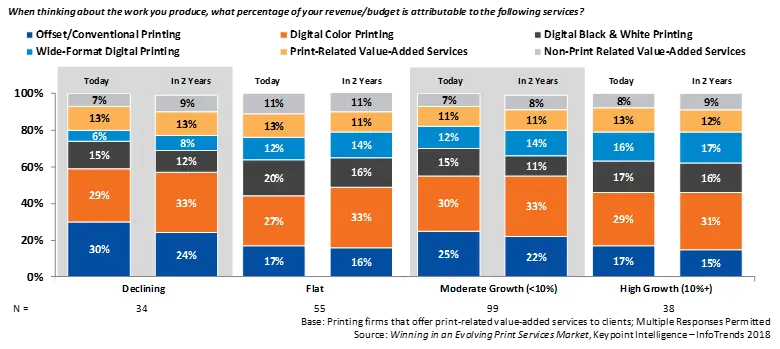
To obtain a better understanding about expectations for future growth, printing companies were asked about the types of services that drove their revenues today and how they expected this to change over the next two years. Regardless of revenue performance, firms across all categories recognize that future growth will stem from a stronger reliance on digital color printing, wide-format printing, and non-print related value-added services.
Figure 3: Revenue from Services – Current vs. Future
The Bottom Line
Focusing on value-added services may be more important now than it has ever been before. Organizations that ignore this best practice may find it increasingly difficult to grow their revenues and align their value to their clients’ business needs. Although course correcting and taking a new approach may seem daunting, many of today’s top-performing firms have discovered that value-added services can be a primary driver for growth. Particularly in today’s uncertain environment, all print distributors are working to keep their offerings fresh and current. Value-added services are a great way to change the conversation and shift the focus away from price.
Eve Padula is a senior consulting editor for Keypoint Intelligence – InfoTrends. Her areas of expertise include business development strategies, customer communications and wide format. She is responsible for creating and analyzing forecasts, analysis, research reports and multi-client studies. She also manages the writing, editing and delivery cycles for various types of blogs and other deliverables.