

Job Onboarding: Common Problems and Fixes
This article previously ran in the August 2020 issue of PS Magazine.
Why Is Job Onboarding Important?
In Steven R. Covey’s legendary book, “The 7 Habits of Highly Effective People,” the highly referenced second habit is to “Begin With the End in Mind.” Simply put, this means to begin each day, task or project with a clear vision of your desired direction and destination. This advice offers merit that is difficult to dispute. When we’re thinking about job onboarding, beginning with the end in mind can help make it easier to identify the actions and efforts that will be required to achieve the desired outcome.
Although the first desired outcome that likely comes to mind is finding a way to reduce costs, it’s important to never lose sight of an opportunity to improve your customer’s experience. Today’s market is wildly competitive, so a disappointing customer experience can quickly cost you valuable business. To meet (or hopefully surpass) the expectations of today’s discerning customers, you must examine the job onboarding process.
Common Challenges
Let’s start with a simple example. Suppose you finally land a new customer you had been courting for over a year. This new customer has concluded that your company’s ability to respond to their needs with insight and value exceeds the experience that could be offered by any of your competitors. It was a true achievement to earn this business. The first order is ready to be placed, and all parties involved are excited about the opportunity to work together. You’ve already established a great foundation, so what could go wrong?
Unfortunately, anyone who has been in the print business for a reasonable length of time will know that there are several opportunities within the job production process where the lines of communication could break down.
To start with, how are you going to ensure that the customer’s vision for each project is delivered as expected? In many cases, the description of that customer’s vision will be handed off several times through a variety of people, processes and departments. Furthermore, these people will have their own ideas about what will be required to bring the job to its final form. Although some businesses would argue that they avoid miscommunications like these by following a well-established set of core processes, unexpected disruptions are common and sometimes inevitable. Any questions that surface after hand-off, last-minute customer change requests or a momentary break in your supply chain can be enough to derail even the most promising project.
According to recent research from Keypoint Intelligence, many bottlenecks can arise between the sale of a print job and the delivery of that job. The most significant bottlenecks, however, seem to appear during the job onboarding process.
When survey participants to Keypoint Intelligence’s 2020 North America Production Software Investment Outlook study were asked about the biggest inefficiencies in their current workflow, nearly a quarter of respondents cited job onboarding. This might be very closely tied to the No. 1 response of dealing with a high number of small jobs — more jobs mean increased complexity and a greater likelihood that something will go wrong at some point in the process, which makes the job onboarding process inherently more complicated.
Primary Workflow Issues/Inefficiencies
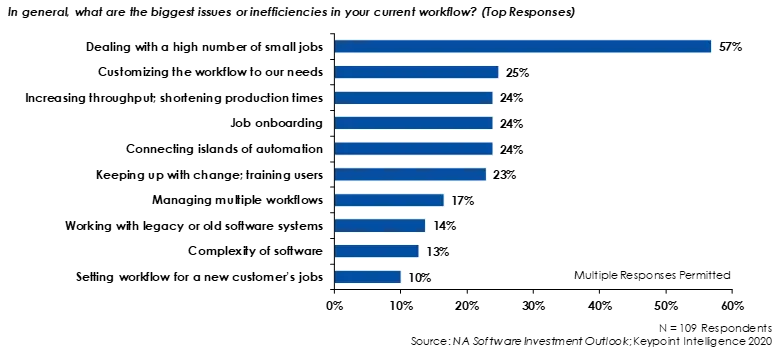
Even the most experienced and successful print service providers can uncover opportunities to improve job onboarding. Although file formats are trending toward standardization and automation can reduce the number of times that a file must be touched, getting a job into the system and ready for production remains a challenge.
Some processes are still largely manual, including the practice of verifying that the information on the job ticket matches the quote and addressing any discrepancies. Even if all of the information about a particular job has been neatly organized on a job ticket, bottlenecks still exist. There are challenges in working with files that might need special fonts, proper images, or design modifications to support bleeds or finishing methods. All of these challenges will require some interaction with the customer.
The time it takes to resolve these issues can add hours or even days to the production cycle. Repetitive tasks, particularly those that involve gathering additional information from the customer, are always an area of concern. In addition to being costly, these tasks slow down production and put you at risk of failing to deliver on the promised service level agreement (SLA).
Overcoming These Challenges
If you’ve been thinking about finding a more efficient process to onboard jobs while reducing your costs, you’re in good company. When respondents to the same Keypoint Intelligence study were asked to specify the initiatives that described their strategic business direction over the next five years, 57% were planning to focus on reducing costs and improving efficiencies.
Strategic Business Direction Initiatives

To improve efficiencies and identify production costs, you must first take inventory of the incompatible components within your process. Once you’ve identified any gaps, you can assess their impact on your current system and then determine how to get them to work together.
At the same time, however, documenting all steps in the process and interactions with customers during the onboarding process can seem daunting. It’s important to remember that there’s no need to create a complicated 10-page workflow diagram. Start simple. It’s very likely that merely examining the number of phone calls, text messages or emails between team members and/or clients will point to areas of opportunity.
Armed with this new insight, you can create an ideal process for onboarding your clients’ projects. Let’s suppose that the inspection of your current onboarding method highlights the opportunity to set better expectations with your customers right out of the gate. Once you’ve developed and implemented process checklists, you can condense the number of touchpoints and interactions. By creating lists, you can develop a consistent process of repeatable practices that will enable you to deliver jobs to your clients on time and as expected. You might also find that technological investments can help alleviate some bottlenecks.
The Bottom Line
At the end of the day, investing the time in improving your job onboarding process can become a competitive advantage. Once you’ve found a process that works for you, don’t be afraid to promote your newfound capabilities. Sharing the story of why and how you developed your job onboarding process can increase customer confidence as well as loyalty. Think about the development of a job onboarding process as an inexpensive insurance policy that can prevent customer disappointment, or even worse, rework.
Above all, make sure your company is easy to do business with. Even the best investments in people and technology will fall short if your customers consider it a chore to work with you. Take the time to examine your job onboarding process today — doing so can provide measurable and repeatable results.
Karen Kimerer is the director of production services for Keypoint Intelligence – InfoTrends. She has experienced the many challenges of expanding current market opportunities and securing new business and has developed a systematic approach to these opportunities, addressing the unique requirements of becoming a leader in our changing industry.