

Selling Personalized Print Campaigns
The article previously ran in the April 2020 issue of PS Magainze.
We’ve moved into another new decade, and print vendors are rapidly investing to stay innovative. Marketing spend is on the rise, with most organizations turning to direct marketing (i.e., forgoing a third-party retailer and selling right to the public) as the answer to capturing and keeping consumer attention. While much of this spend is occurring in the digital space through social media channels and email campaigns, a good portion is still being invested in traditional print efforts, particularly direct mail.
While many direct marketing campaigns remain focused on reaching the masses, greater portions are increasingly targeted. Keypoint Intelligence believes that print vendors can separate themselves from the competition and become industry leaders by maximizing the impact of these personalized campaigns. Those who rely on older methods of mass marketing may find themselves left behind, as consumers are becoming less responsive to generalized forms of advertising.
The Need to Prioritize the Customer Experience
The idea of the customer experience is not new; businesses have been holding marketing meetings and formulating strategies on how to keep clients engaged and happy for decades. From mapping the customer journey, to learning the psychology of the point of sale, to identifying the importance of retention and the value it can bring, this is a process that is already well understood. With the customer experience already being so established, it’s natural to wonder why it has become such a focal point. There is no singular answer, but rather several important developments that either shifted customer preference or made companies realize where the real meat of their revenue came from.
The latter began in 2008 when the United States entered a major recession. Many businesses saw their revenue decrease sharply and profits vanish as the economy spiraled and the government scrambled to contain the problem. Recovering from the recession took many months, and businesses had to concentrate on their primary profit revenues to stave off bankruptcy. In evaluating their key areas of profit, many firms evaluated their most important customers. So, who makes more money for a company: returning customers or new customers?
The answer is returning customers — by a lot. Data from Bain & Company, in coordination with Harvard Business School, showed that even a small 5% increase in customer retention can transform into a profit increase ranging from 25% to 95%. On top of this, it is also cheaper to rely on returning customers. Capturing the attention of any audience is difficult. There are countless channels of communication, and the average customer is bombarded by marketing messages and advertising campaigns. Companies must spend to capture customer focus. Information compiled by Invesp stated that it costs roughly five times as much to entice a new customer as it does to retain an existing one — and this was back in 2015. The market is fiercer now than it was then, so Keypoint Intelligence believes that this cost has increased.
Furthermore, and not surprisingly, it is inherently easier to sell to existing customers. The first step — convincing a customer to buy from a brand — has been completed. The customer has already made a purchase, so marketers need only convince that customer to keep buying. This should be easy provided that the customer was satisfied with the purchase. Marketing Metrics found that the probability of selling to an existing customer was about 65%. Meanwhile, the probability of convincing a new customer was roughly a third of that at best.
Appealing to returning customers means meeting their preferences, and these preferences have shifted greatly with the proliferation of Amazon, Facebook and other digital marketplaces/social media networks. Online experiences thrive on personalization. Everything is tailored to what the user looks at and interacts with. This has greatly reduced average online shopping time and created a new set of expectations. Today’s customers aren’t perusing in a leisurely fashion anymore; they expect companies to communicate relevant products to them immediately, and they won’t see the point of chasing after anything when so many companies will bring comparable products right to them.
Everything Begins With Data
If print vendors hope to succeed with personalized campaigns (print or digital), they must have a reliable big data infrastructure. In other words, their internal operations must be optimized to take in copious amounts of information, process it in an appropriate timeframe, and then feed this data back in a way that empowers decision makers to act on it. It makes no real difference whether they intend to use this information for a direct mail campaign or a social media push, as all that changes are the parameters of the data collection.
If this sounds like an investment, that’s because it is one. Companies cannot simply hope to move to big data processing and do it on a whim. According to Keypoint Intelligence’s research, the primary reasons that organizations did not invest in more personalized marketing communications included cost (30%), difficulty with design (29%) and difficulty managing (27%).
Businesses that are hoping to successfully run personalized marketing campaigns must position themselves for success ahead of time. This means removing the inherent data silos of the traditional organizational structure, where research talked only with research, marketing with marketing and so on. Internal communications must be fluid if they are to be processed in time to execute effective campaigns.
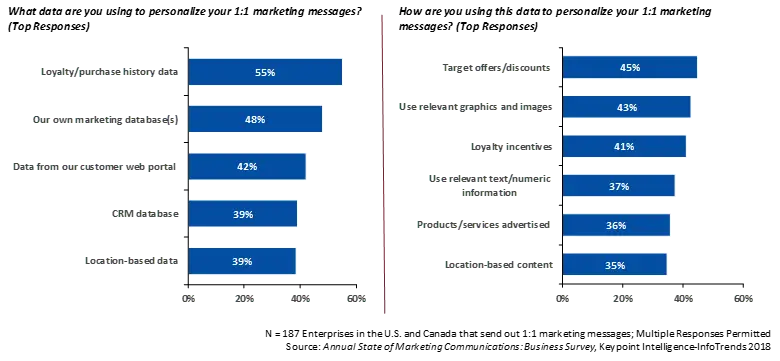
When determining which information to use, Keypoint Intelligence found that loyalty/purchase data is the most commonly used fuel to power personalized marketing messages (55%). Organizations also rely on their own databases (48%), while others trust a customer web portal (42%). Although location-based data lags at this time, it is expected to grow more robust with the rollout of 5G throughout 2020.
Data on Personalized Communications
How Direct Mail Makes for a Satisfying Customer Experience
Now, let’s address a question that is likely on many people’s minds: With all this use of big data and digital infrastructure, isn’t it antiquated to return to something as old-fashioned as direct mail? Although businesses should certainly not be relying on direct mail (or any kind of print) to solve all their marketing challenges, the reality remains that print is an established, viable tool that has demonstrated continued effectiveness with all age groups. Particularly when personalization is involved, printed communications increase engagement rates and drive further customer action.
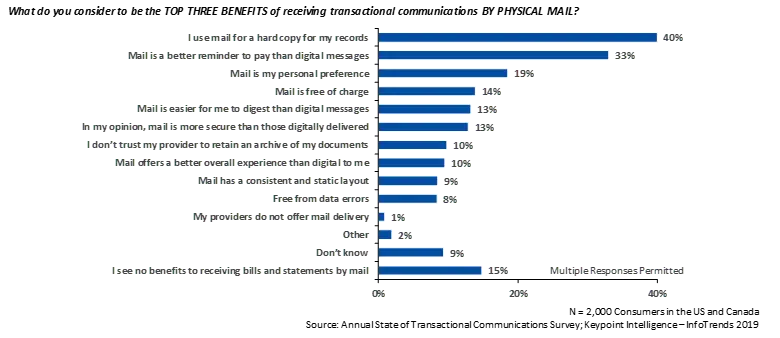
When it comes to marketing, it’s important to focus on the second response in the graph below. Mail is a better reminder to pay than digital messages. When paying a bill, it helps to have a tangible memory aid. Marketing is no different. While email has its uses, it is never as present as a piece of physical mail (no matter how many notification reminders are present on desktops, smartphones or tablets). Keypoint Intelligence has found that this tangible quality is consistently valued, whether it be for transactional statements or marketing materials.
Benefits of Mail-Based Communications
Moreover, customers are also more likely to pay attention when a piece of marketing content is personalized. Using a client’s name helps, but relevant coupons (for example, don’t send a Target promotion to an area with no Target within 50 miles), seasonal celebrations and offers based on search habits can greatly enhance response rates.
To Sell Print, Go Digital?
While there are many ways that print campaigns can be improved through digital augmentation, Keypoint Intelligence will focus on two. The first involves customer experience: the value of an omnichannel approach. Customers want to have their preferences met, and forcing everybody to capitulate to a single set channel is guaranteed to drive down response rates. Millennials who prefer interacting with smartphone apps may be turned off by an exclusive direct mail campaign, and baby boomers may not appreciate constantly entering their email addresses for initiatives they’d rather receive in their mailboxes.
By being prepared to serve both channels, print vendors are positioning themselves for greater success — not just with consumers, either. Keypoint Intelligence’s research has shown that companies frequently prefer the same provider when outsourcing print and digital marketing communications.
Outsourcing Both Print and Digital Marketing Communications

Marketing agencies are just as pressured to respond to market changes as print vendors and, therefore, seek easy partnerships. This means that more marketers prefer to resolve all their marketing needs with the same provider, which is a trend that’s been fueling consolidation in the space as some print vendors join forces with digital specialists to provide more versatile offerings to their clients. Vendors hoping to become leaders must be proactive on this front. As ironic as it might sound, acquiring some digital talent may help empower the print campaigns of tomorrow.
Selling personalized print campaigns can be challenging, but it is increasingly essential. Through internal workflow optimization, print vendors can set themselves up for big data processing, enabling them to better respond to clients’ personalized expectations. Direct mail and other print campaigns remain a profitable channel, but print vendors that rely on partnerships or acquisitions to obtain digital specialization can optimize revenues and further diversify their product portfolios.
Colin McMahon, senior editorial analyst at Keypoint Intelligence – InfoTrends, supports a variety of consulting areas. He creates and refines written content such as forecasts, industry analyses, research reports and multi-client studies. A graduate of Concordia University, McMahon is a published author, avid researcher and enjoys working with the latest technological developments, including in the areas of augmented reality, virtual reality and cybersecurity.