

Understanding Industry Trends for Business Success
Consumer preferences are changing at the speed of light, and technology continues to transform the landscape of client engagement. As a result, today’s brand solutions providers find themselves at a critical juncture. Industry leaders recognize that focus must extend beyond offering quality products and services. To remain relevant, providers of print and promotional products must acknowledge and respond to the dynamic shifts in communication preferences.
There’s no question that our industry is saturated with options, but survival is not about being the biggest entity or the one with the most tenure. Innovators realize that true differentiation lies in agility and the ability to respond quickly and adeptly to a shifting consumer environment. To truly prosper, providers of print and promotional products must embrace change and cultivate an intimate understanding of the markets they serve. This article delves deeper into customers’ communication preferences, exploring new data from Keypoint Intelligence that reveals the trends shaping today’s direct marketing spend.
The Blend Begins
Identifying and exploiting new markets will come easier if you have a clear understanding of how your current offerings meet your most valued customers’ needs. To that point, a surprising statistic emerged from Keypoint Intelligence’s most recent direct marketing communications survey. As shown in the chart below, 88% of the marketers that outsource their print use the same providers to handle the delivery of their digital communications. In addition to being indicative of the versatility of these providers, this statistic highlights the trend we’re seeing in big corporations to approach their marketing efforts with a seamless blend of traditional and digital marketing strategies.
Figure 1: Same Provider for Direct Mail and Digital Communications

Why the Blend Works
Having the same communication provider handle printed and digital communications helps ensure consistency in branding and messaging. For enterprises, it’s often easier to deal with a single partner for all communication channels than juggling between multiple entities.
With a blended approach, brands can create holistic campaigns that play off each other. For instance, a quick response (QR) code on a printed postcard that leads to a personalized digital landing page delivers more value and information than a standalone static postcard. Behind the code, important topics — like how the brand addresses sustainability — can be explored in greater detail. As another example, a near field communication (NFC) tag embedded on a branded tote can link to an app like Google Pay or Apple Pay, enabling the recipient to order more promotional products quickly and securely. Providers that fail to deliver both physical and digital marketing campaigns are likely missing out on a good amount of revenue and may be putting themselves at risk of losing the business they do have.
Navigating the Direct Marketing Labyrinth
Brand owners who rely on print providers to manage both print and digital direct marketing are rarely just a phone call away. To get a seat at the table with them, you must be present where they hang out. Just like consumers, the digital transformation continues to reshape how direct marketers access information. Keypoint Intelligence’s research confirms that channels like social media, company websites and even webinars offer real-time insights for direct marketers. Looking further down the list, the numbers indicate reliance on intermediaries is waning.
Figure 2: Sources of Direct Marketing Information
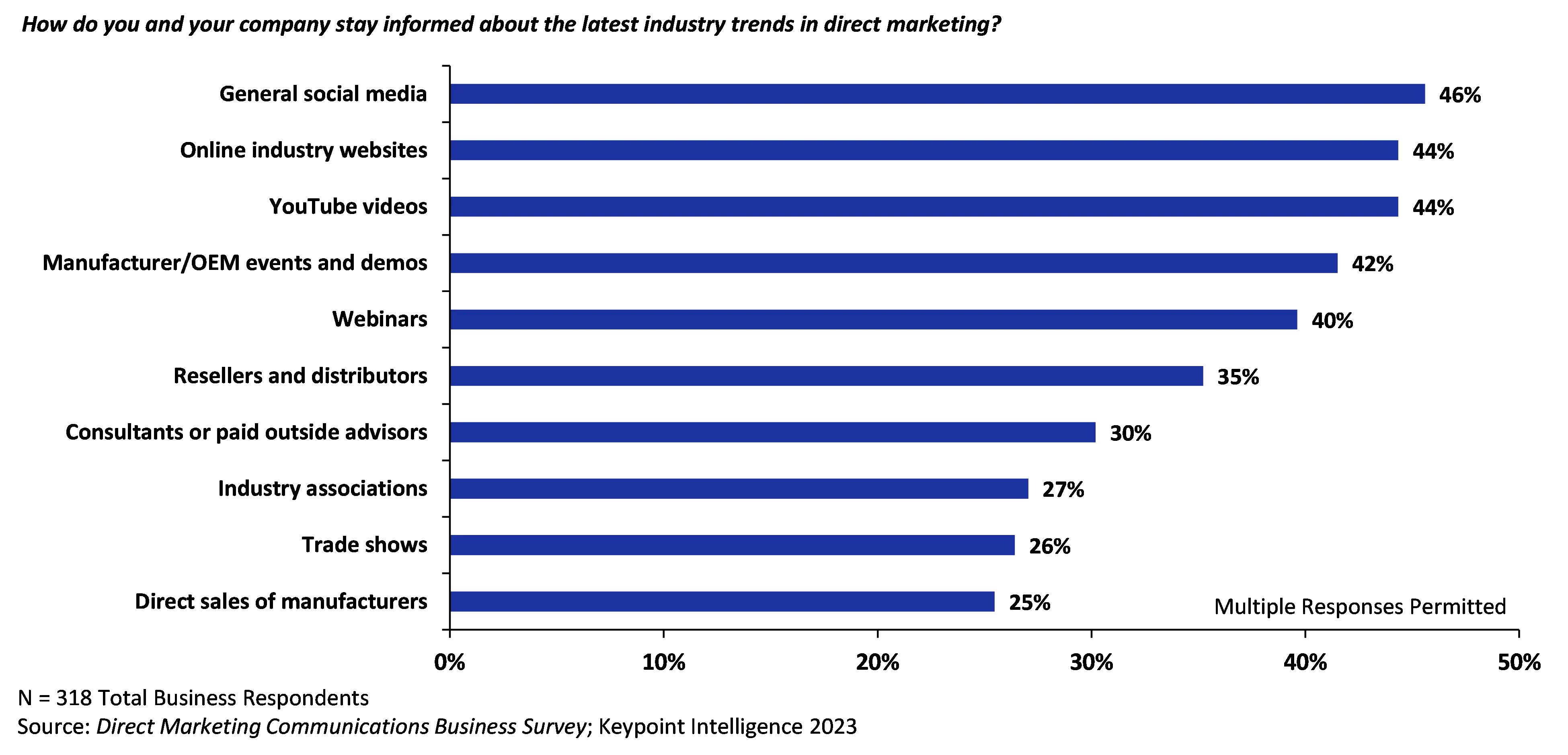
This trend showcases the industry's move towards a more direct, unfiltered and instantaneous mode of knowledge acquisition. It also underscores the immediate need for resellers and distributors to redefine their roles and contributions in this digital age.
From Transaction to Interaction
For brand owners of all sizes, the key element that distinguishes them from their competition is customer experience (CX). Survey data from Keypoint Intelligence suggests a staggering 91% of marketers have a dedicated strategy or department focusing exclusively on CX and process improvement. Let's dive into the story behind these numbers.
CX is the new currency. It’s no longer just about the product or service offered, but how it's delivered and experienced by the customer. A satisfied customer is more likely to be a loyal advocate, so more and more businesses are prioritizing CX as an essential component of their long-term success. In our age of online reviews and instant feedback, understanding and refining the customer journey has become paramount. A dedicated CX department can more efficiently capture, analyze and respond to customer feedback, ensuring continuous improvement.
It's widely acknowledged that retaining a customer is generally more cost-effective than acquiring a new one. Businesses with a solid CX strategy often report higher customer retention rates, which is important because delighted customers are more likely to become brand evangelists.
Where do providers of print and promotional products fit into this trend? The modern business world is no longer just about the transaction; it's about the interaction. The survey outcome reflects a paradigm shift from a product-centric to customer-centric approach. Check your messaging and sales approach — are you product-focused or customer-focused? Can you precisely articulate how your products and services will add to a better customer experience with the brand owners you speak to?
Think beyond the product or services your customers typically buy and take a holistic approach. You can do this by:
- Asking them which channels they most often use to gain referrals, acquire new customers or reactivate those who no longer buy from them
- Uncovering how they use social media to cross sell or upsell
- Identifying the channels they find most effective to retain customers and reinforce brand awareness
Odds are good that your customers are not taking a one-size-fits-all approach to each of the very important marketing disciplines mentioned above. Once you discover the answers to these questions, you’ll be better positioned to capture more marketing dollars while demonstrating your approach to the important “customer interaction” trend. The CX revolution is here to stay, and brand owners must continue to invest heavily to guarantee that they offer an excellent journey from start to finish.
The Evolution of Pricing Strategy in the Modern Era
Delivering value often comes at a cost, so does this mean offering remarkable CX should come with a higher price tag? It depends. In the early days of commerce, the formula was simple: buy low, sell high. The emphasis was purely on profits. As markets matured, however, consumer behaviors evolved. Today’s business landscape is more complex, and a rudimentary approach has begun to show its limits.
Enter the era of strategic pricing, where decisions are not just about bottom lines but about boosting overall company value. A critical driver of this shift toward value-based pricing is the rising importance of sustainability and corporate social responsibility (CSR). Modern consumers and organizations are often willing to pay a premium for products that are ethically sourced, eco-friendly or contribute to a social cause. This willingness is not rooted in the direct benefits they receive but in the broader value that these products represent. So the real question is, how do your products and services add value?
A company using sustainable materials, paying fair wages or investing in community projects might have higher operational costs, but their product pricing reflects these values. In such scenarios, businesses understand that price is not just a monetary transaction and realize their contribution to a larger cause can be incorporated into their brand story.
As the business world steps further into the 21st century, the rudimentary models of yesteryear are being replaced with intricate, value-driven models. Pricing is not just a reflection of what it takes to make a product, but what that product stands for. Firms that recognize this shift and align their strategies accordingly will see revenue growth as well as an invaluable growth in company value.
The Bottom Line
Today's print and promotional product buyers are more informed than ever. They are seeking customization, speed, sustainability and value. Their needs and preferences evolve with societal shifts, technological breakthroughs and even global events. Businesses that align their strategies with these shifts can ensure that they are not just meeting but anticipating the demands of their clientele.
For those serving these important organizations, there's no magical formula to guarantee success. A combination of vigilance, adaptability and innovation can set providers of print and promotional products on a trajectory for sustainable growth and profitability. This proactive approach, which melds both current insights and future predictions, is key to thriving in an increasingly fluid marketing landscape.
By Karen Kimerer, group director, Keypoint Intelligence