
Pioneering Sustainable Solutions in the Promo Products Industry
 Ben Grossman, co-president of Grossman Marketing Group and founder of SwagCycle (left), is shaking up the world of sustainability in the promo products industry. In this Q+A, we dive into Grossman’s passion for responsible waste management and the remarkable impact of SwagCycle, a platform that repurposes and recycles unwanted branded items.
What motivated you to focus on responsible waste management in the promotional products industry?
I have been deeply involved in sustainability causes for many years, and I have frequently tried to bring environmentally responsible solutions to our company and our industry. SwagCycle is an outgrowth of my lived experience in the branded merchandise industry.
I have seen firsthand how, when companies rebrand, get acquired or change marketing messaging, their swag can become obsolete almost overnight. Unfortunately, the path of least resistance for companies has historically been to throw these perfectly good items away — not because they don’t care about the environment, but because these companies are so busy with other priorities that they don’t have time to figure out a sustainable solution.
Recognizing this problem of leftover swag, I set out with my team to build a platform to enable companies to donate their extra merchandise to worthy and vetted charities, as well as recycle or upcycle their products if brand guidelines dictated that the items couldn’t remain in the marketplace. Thus, SwagCycle was born!
How is this an industry-wide issue, and how others can get involved?
The entire planet is facing a waste crisis. As marketing services professionals, we have a role to play in reducing the amount of waste that gets created and ends up in a landfill.
First and foremost, this is achieved through charitable donations to causes in need. One example is our partnership with the team at the YMCA in Houston.
In the summer of 2021, they reached out to SwagCycle as they prepared for the arrival of more than a thousand refugees from Afghanistan on Special Immigrant Visas. The team at the YMCA told us they needed everything from clothing for kids and adults, backpacks, coffee mugs for temporary housing and even fun, light-up items for local teenage youth mentors as a gesture of gratitude. We have since facilitated more than 30 individual corporate donations worth several hundred thousand dollars.
Some companies come to us and can’t donate products due to brand guidelines or compliance reasons. Our goal is to find ways to keep these items out of landfills through recycling and upcycling initiatives.
We often get asked if recycling items, instead of simply discarding them, is good for the environment. The answer is a resounding yes! Landfill decomposition releases methane, a greenhouse gas with global warming potential about 85 times higher than carbon dioxide. In 2021, methane emissions from U.S. landfills equated to the greenhouse gas emissions from driving about 23.1 million cars for a year. Keeping recyclable items out of the trash can limit these emissions.
About 20 million tons of household recyclables are thrown in the trash in the U.S. each year. If all those materials were recycled instead, it would reduce greenhouse gas emissions by 96 million metric tons of carbon dioxide, equivalent to taking more than 20 million cars off U.S. highways. Here’s an article we wrote with more details on why recycling matters.
What has been the most rewarding aspect of SwagCycle's work in repurposing and recycling unwanted branded items?
Each project begins with a simple request from a company or organization looking to responsibly divest of their merchandise. The first question we ask is whether the goods can live on in the marketplace, with the goal of facilitating a donation to one of our hundreds of charitable partners around the globe. This is our top recommendation, to make a difference in the community and to keep good quality items in use, which has the least impact on the environment.
Once we understand the scope of the products approved for donation, we send notifications to our partners, including such wonderful organizations as YMCA, Delivering Good, Giving World, Birth Brite Foster Closet and Dress for Success, to assess their interest. When a match is identified, we provide the donor organization with detailed information about where the items will go and how the charity intends to use these items, to make sure the donation fits the donor’s priorities.
Representing our donor partners’ brands in the best possible way is an essential SwagCycle value. This philanthropic facilitation is some of the most meaningful work we do on an ongoing basis, and it’s an honor to make a difference in the community — locally, nationally and globally.
Can you share any examples of how SwagCycle has made a positive impact through its charitable donations?
One of our largest projects was supporting Facebook’s rebrand to Meta, the most prominent rebranding effort in recent business history. We heard directly from the marketing team at Meta, looking to donate nearly 20,000 items with a value of nearly $100,000. The project became a bit complicated when they wanted to make a large donation in the U.S. and the U.K.
The U.S.-based items were at their vendor’s warehouse in Georgia. The goal was to get them in the hands of those who needed them most without needing to truck them across the country, which costs money and generates carbon emissions. We spread the word and were thrilled to facilitate the U.S. donation to Atlanta-based Caring For Others, Inc. through our partners at Delivering Good. Caring For Others, Inc. is an international human services organization that provides food, clothing and a continuum of services to families struggling with the effects of a natural disaster, impoverished circumstances and temporary misfortune.
For the U.K.-based items, we partnered with our friends at Giving World. They are an organization that works with businesses to donate some of the £2 billion surplus products generated in the U.K. every year, and then redistribute them to people living in poverty who rely on them for survival. Some of these items went to Ukrainian refugees, both close to the war front in Poland and in the U.K.
Subsequently, we helped facilitate the donation of more than 6,000 pairs of baby, toddler and youth socks from Meta to the California Kindergarten Association.
The mission of the California Kindergarten Association is to foster children’s early learning and development by promoting best practices and professionalism in teaching and advocating for high-quality, developmentally appropriate early childhood education.
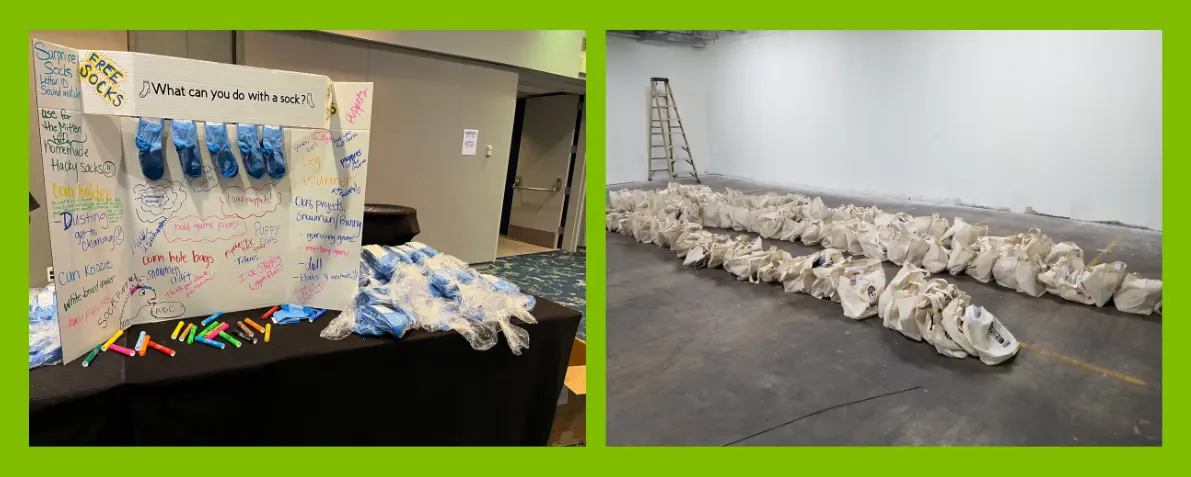
Right: Merchandise gift bags donated by SwagCycle to YMCA Houston. Graphic courtesy of YMCA International Services (Houston).
What kind of impact do you hope to achieve in terms of sustainability and responsible waste management in the coming years?
When we launched SwagCycle, we knew there was an obsolete swag problem, but we are tremendously gratified by the interest that has been shown in our industry’s first-ever platform of this type. It’s been thrilling to see the demand from companies looking to donate or recycle their swag with us, as well as the range of charities that have requested to join our platform. Since launch, we have kept more than 1.5 million items out of landfills and have facilitated more than $3 million in charitable donations!
Although we have completed projects around the globe, the vast majority of our charitable and recycling capacity is in the U.S. In the coming years, we plan to expand internationally. We frequently hear from companies abroad looking for a partner, and we hope to fill this need.
By Rachel Schollmeier