
Trends in Digital Labels and Packaging
This article originally appeared in the March 2021 issue of PS Magazine.
Although it started out normally enough, 2020 turned out to be a year unlike any other when the global COVID-19 pandemic took the world by storm. We navigated through the rest of the year and entered 2021 with the promise of a vaccine, but a great deal of uncertainty remains as this ongoing health crisis is proving to be stubbornly persistent. Questions continue to swirl about COVID-19’s temporary and long-term effects on humanity, the economy and a wide variety of industries. While there is no denying that many market segments were hit hard by the pandemic and subsequent economic downturn, the digital label and packaging industry has ultimately been able to thrive.
Even in an unstable economy with the lingering effects of a global health crisis, many growth opportunities remain in digital labels and packaging. To truly capitalize on these opportunities, print distributors have an opportunity to promote the digital printing capabilities of the printing/mailing companies they represent. Digital technology is a necessity for any printing company that hopes to take advantage of the growing number of short-run orders. Digital printing makes it possible to meet today’s requirements for high-value customization and personalization. It also streamlines the supply chain, reduces warehousing requirements and enables faster time to market. As we move through 2021, ongoing trends and market conditions will reveal even more opportunities in labels and packaging.
Industry Overview
The packaging industry is certainly not new, but it is a large and diverse market that represents a bright spot during COVID-19. Packaging serves as a means to promote, protect and deliver all types of products, regardless of whether they have traditional or more modern requirements. It is also one of the few applications that is not being displaced by electronic technologies. Packaging provides a medium for communicating brand messaging while also enabling digital (online and mobile) interaction. As an added benefit, today’s consumers are intrigued by well-designed and innovative packaging.
Similarly, printed digital labels are used for product packaging in almost all industries, including cosmetics, food and beverage, pharmaceuticals, private labels and marijuana (in locations where cannabis dispensaries have been legalized). The global digital label printing market has experienced healthy growth, largely fueled by consumers’ rising concerns about the legitimacy of the products they purchase, due to widespread counterfeiting of cosmetics, food and beverage, fast-moving consumer goods (FMCG) and pharmaceutical products. Health and safety has also become an area of focus during these pandemic times, and labels can provide consumers with assurances about the food, beverages and other products they consume.
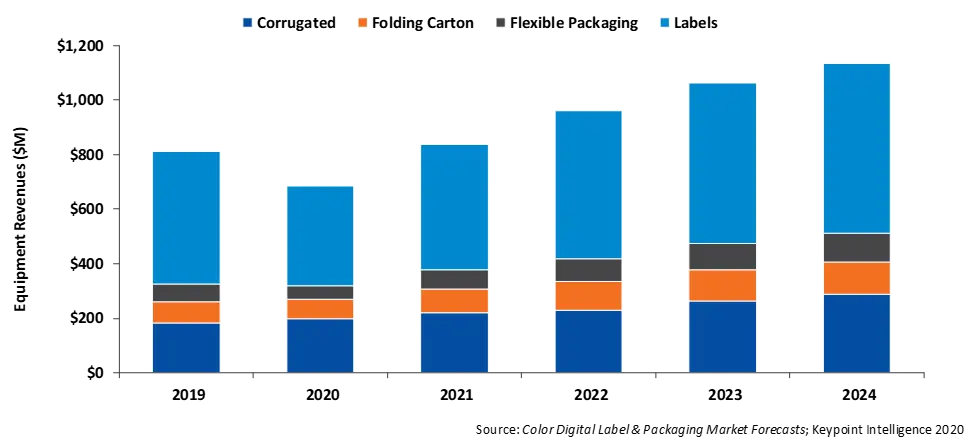
According to Keypoint Intelligence’s most recent forecast data, all segments of color digital packaging and label printing equipment are expected to see healthy revenue growth through 2024. These markets did take a hit during COVID-19, but they are all expected to rebound quickly.
Color Digital Label and Packaging Equipment Revenues
COVID-19: The Great Accelerator
The pandemic has only served to accelerate the changes that were already occurring in the label and packaging markets. The trends were already in place, but they were sped up with the onset of COVID-19. In addition to accelerating e-commerce and the digital transformation, the pandemic also brought about a packaging surge. According to Juan Perez, chief information and engineering officer at UPS, average daily volumes for packaging have increased by nearly 14% over the past year.
The global e-commerce market has been in a state of constant growth since 2014. Statista research indicates that worldwide retail e-commerce sales amounted to $2.3 trillion in 2017 and are projected to reach $4.88 trillion by 2021. Given that these estimates are pre-COVID-19, they are likely on the low side.
The rise of the internet and the ability to make purchases online has taken full force across all industries, and this trend was only accelerated during the lockdown phase of the pandemic when many consumers — and businesses — chose to heed the advice of experts and self-quarantine. Now, even as the economy is reopening, there are some people who simply won’t be comfortable with making purchases in person, regardless of any safety assurances or procedures that may be in place. Even those who do choose to make in-person purchases are likely doing it less than they were in the past. This is partially due to the convenience and ease of e-commerce, and also because many people (even those who work for or own businesses) are now spending more time at home than ever before. This has caused a tremendous spike in the demand for home/business delivery and contactless curbside pickup.
All of this spells big opportunity for the labels and packaging industry, which is, of course, instrumental in supplying everything from takeout containers for restaurants to corrugated packaging for deliveries and protective packaging for personal protective equipment (PPE). Many of these packages also require digital labels, so it should come as no surprise that the label and packaging industries have uncovered new growth opportunities.
Opportunities for Growth
Self-Adhesive Labels
Some businesses specialize in the design, manufacture and supply of self-adhesive labels. With today’s printing technologies, the application opportunities are limited only by the imagination. Businesses can use these labels to creatively communicate with and inform customers and prospects in virtually any industry — retail, health care, education, automotive, technology and more.
Furthermore, digital printing makes it possible for these labels to be printed on demand and affixed to almost any surface. This means that short runs of labels can be created for holidays, regional events, trial applications or limited time offers. In addition to presenting content in new and creative ways, businesses now have the option to create personalized labels for audiences of one. Consumers, too, can implement these labels for a similarly countless array of uses.
Tangental Work
The label and packaging industries have long been associated with increased opportunities for tangential work. Firms that have historically created labels or packaging for very specific applications have more options for branching out than ever before.
For instance, plenty of brand owners were supplying labels to vertical industries (e.g., health care, retail, personal care, education) before the pandemic unfolded. Now, as the economy starts to reopen, brand owners are finding that these same verticals have a sudden, strong need for additional types of labels that can assist with social distancing, touchless transactions or check-ins, wayfinding or foot traffic control. Even though a great many businesses have experienced revenue declines and lost opportunities because of COVID-19, savvy players within the label and packaging industries have largely benefitted from the pandemic by focusing on tangential opportunities.
Sustainability
Although sustainability has always been an important issue for the label and packaging industries, COVID-19 has shifted the priorities of consumers and businesses alike. During the pandemic, concerns about hygiene and food safety began to take priority over the sustainability of certain packaging substrates. Even so, flexible packaging offers a number of sustainability benefits, including lighter weight, easier transport, extension of product shelf life, reduced waste and a high product-to-package ratio.
The labels industry has made great strides in sustainability by reducing materials waste, minimizing energy consumption and better managing chemical disposal. For several years now, label companies have taken various steps to address the environmental concerns that face the industry. Certified paper stocks and other eco-friendly materials also play a role in helping label companies and buyers remain environmentally friendly by reducing energy consumption/waste, streamlining processes to improve efficiency, and recycling liner and label stock waste into new types of packaging material.
The Bottom Line
Rapid technological developments and shifting expectations are causing dramatic changes in the label and packaging industries. COVID-19 has only served to accelerate the focus on personalized label and packaging applications. Even in an unstable economy with the lingering effects of a global health crisis, many growth opportunities remain in digital labels and packaging. Labels and packaging are a tangible way for businesses to connect with customers regardless of physical location, so impressions can still be formed even if people aren’t venturing out.
Eve Padula is a senior consulting editor for Keypoint Intelligence – InfoTrends. Her areas of expertise include business development strategies, customer communications and wide format. She is responsible for creating and analyzing forecasts, analysis, research reports and multi-client studies. She also manages the writing, editing and delivery cycles for various types of blogs and other deliverables.