

The Changing Roles of Customer Care
This article previously ran in the February 2020 issue of PS Magazine.
Technology in the print industry has transformed operations in every aspect of business, from order-taking through the manufacturing process and billing queries. Changes in technology have become a constant in our lives both in and out of the office. While Smart Print Manufacturing and Industry 4.0 is driving the evolution of print workflow and production processes, they have also generated changes in the roles and responsibilities for customer care. The ways customer service representatives and sales associates manage customer inquiries and sales communications have changed and continue to evolve (cue the question, “What about AI?”) in today’s print organizations.
Market research firm InfoTrends, a division of Keypoint Intelligence, surveyed 24 mid-tier print service providers to learn about the professionals who make up their customer care teams. The survey asked how accounts are assigned to them, the roles they perform, how they are compensated and how much time they spend serving clients.
As you read through the findings, think about how the roles of your customer care teams have changed. How could you harness the power of technology to better serve your customers and to grow your print organization?
Who Is On the Customer Service Team?
Print service and distributors’ customer care teams include customer service representatives (CSRs), sales representatives, account managers and production/product managers. These are the top job titles associated with customer care teams, but you’ll also find titles like project manager, account coordinator, customer service specialist, customer resource representative or sales executive. While the titles change across companies, the roles and responsibilities are similar, encapsulating one obvious goal: managing the customer relationship from lead generation through product delivery.
Not surprisingly, sales representatives are the indispensable core of the customer care team. While all respondents had at least one sales rep, some of them operated without dedicated professionals in the other three positions — 8% had no customer service representatives, 17% employed no production/project managers and 33% employed no account managers.
Assigning Accounts
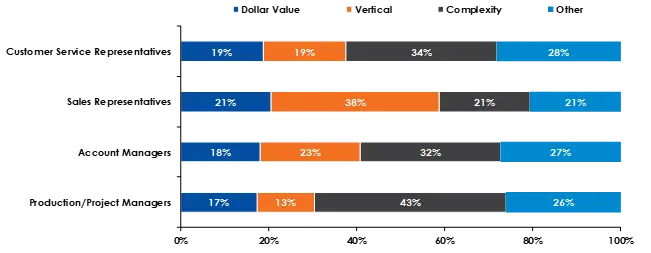
Assigning accounts is an essential decision point for any business manager because these employees will ultimately ensure proper care at every point of the customer journey. InfoTrends asked the respondents to describe the criteria they used to assign accounts to specific employees. Their responses included factors such as dollar value, vertical market and job/project complexity. Figure 1 outlines the top consideration for various roles.
Figure 1: Primary Consideration When Assigning Accounts
Source: Print Provider Survey; Keypoint Intelligence – InfoTrends/Ing 2018
The complexity of the project was the top consideration when assigning accounts to employees in every specified position except for sales representatives, where the vertical market was the primary factor. Complexity was especially important when assigning accounts to production/project managers, with 43% of companies citing it as the top consideration. Additional criteria also play a vital role in determining the assignment of customer care personnel, as evidenced by the substantial share of “other” responses in Figure 1. Follow ups with these respondents indicated that judicious and/or efficient distribution of day-to-day workload was their top priority. Others reported splitting assignments by line of business or mail application characteristics (e.g., tasking certain employees with fundraising correspondence and others with transactional work, or assigning a separate sales rep to presort mail). Seniority, sales origination and the working relationship between account managers also factored into respondents’ assignment strategies.
Roles and Responsibilities
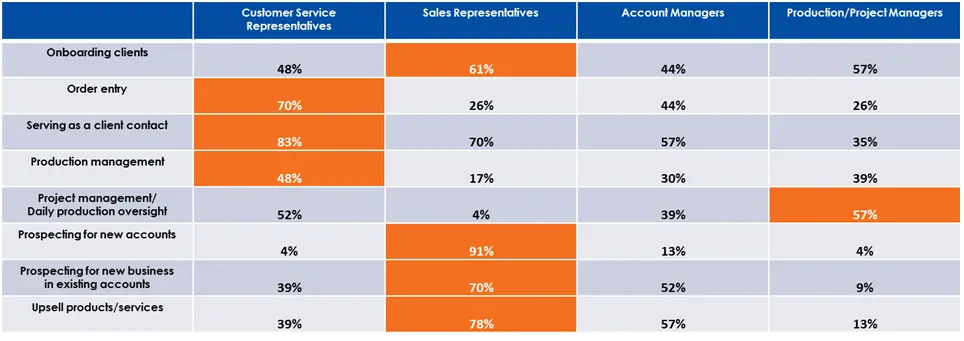
The next section of the survey asked participants about the customer care representatives who performed specific tasks and how much time they spent on these assignments now in relation to two years ago. Table 1 lists the results and provides some directional insight on these professionals’ expanding duties.
Table 1: Assigned Tasks by Title – General (Multiple Responses Permitted)
Source: Print Provider Survey; Keypoint Intelligence – InfoTrends/Ing 2018
Specifically, here are some noteworthy points about the changing roles within their customer care teams:
- Customer service representatives are doing more order entry today than they were two years ago.
- Customer service representatives are spending more time handling production management, project management and daily production oversight.
- Sales reps are spending more time prospecting for business in both existing accounts and new ones. These representatives are also spending more time upselling products and services.
- Although a small percentage of participants do offer bonuses (most commonly to sales representatives and account managers), customer care professionals in the surveyed positions usually prospect for business and upsell opportunities as part of their usual duties.
- One organization reported rewarding its account managers with commissions for expanding clients’ service lines, and another stated that the company once operated on a commission structure but has since transitioned to higher base salaries instead.
In general, customer care representatives spend the same amount or more time on the surveyed tasks today than they did in the years prior. In areas where employees are spending more time on assignments, respondents reported that these expanding roles are tied to the increasing complexity of their companies’ offerings and the volume they have gained by winning new clients.
Time Devoted to Customer Care
Although the majority of respondents reported that the length of their service calls has remained largely unchanged, call lengths did vary widely from company to company, ranging from five-minute check-ins to multiple contacts totaling a few hours. Over a quarter of respondents said that their service calls had grown longer over the past two years because of the increasing complexity of their services, product offerings and postal rules. Another 11% of respondents reported that the volume of service calls had increased. These respondents had increased their client lists, and some reported volume increases as high as 25%.
Further, InfoTrends asked respondents to evaluate how much time they spent on their most profitable accounts compared to the least profitable ones. As expected, most companies spent the greatest amount of time on their most profitable accounts. The average ratio of time spent on the most profitable accounts versus the least profitable for all respondents is 4 to 1 (most profitable to least profitable).
Takeaways
Take a moment to consider how your print organization measures up or aligns to your peer’s customer care benchmark. Have you taken a head count recently or how your employees are segmented? Are the roles and responsibilities aligned with your optimal customer journey map? As you review the structure and purpose for each individual on your customer care team today consider the following takeaways:
- Make sales representatives your priority. Business growth hinges on your sales organization. Create a strong sales team and then make investments in training these individuals so they can form the core of your customer care contingent.
- Customer service representatives can serve as pinch-hitters for production/project managers. Customer service representatives perform a number of roles, and nearly 50% of our survey respondents task them with product management and daily project oversight. Consider expanding your representatives’ training rather than investing in separate production/project managers.
- Account managers can be your stealth MVPs. Although account managers do not take on a primary role in any of the surveyed tasks, participants report tasking them with a wide array of jobs. Because of the broad range of tasks they are expected to perform, account managers might be the most versatile members of your customer care team.
- Sales and customer service representatives are the most essential roles, but account managers can fulfill the greatest number of responsibilities. When it comes to assigning accounts, complexity and vertical market play the most critical role. Most participants devote more of their time to their most profitable accounts, and the amount of time spent fielding service calls is generally the same as it was two years ago.
By Nichole Jones